


Dog training is one of the most debated topics in the canine world—and often one of the most misunderstood. Many discussions frame training methods as opposing sides, but the reality is far more complex. To make informed decisions for your dog, it helps to understand not just what these methods are, but why they exist, how dogs actually learn, and how each approach is applied in real life.
Two of the most commonly discussed training philosophies today are positive reinforcement training and balanced dog training. While both rely on learning theory, they differ in how behaviors are taught, reinforced, and corrected.
How Dogs Learn: A Foundation in Behavioral Science
Before comparing training methods, it’s important to understand how dogs learn in the first place. All dog training—whether reward-based, balanced, or otherwise—is rooted in behavioral science.
Dogs learn through association and consequence. They repeat behaviors that lead to desirable outcomes and reduce behaviors that result in unpleasant outcomes. This isn’t about morality or intention—it’s biology.
Classical Conditioning vs. Operant Conditioning
Dogs learn in two primary ways:
Classical conditioning is passive and involuntary. Dogs form associations between things that happen together. For example, a dog may learn that the sound of a leash means a walk is coming, or that the doorbell predicts visitors. These emotional responses happen automatically.
Operant conditioning, on the other hand, is active learning through consequences. Dogs learn that their behavior affects what happens next. This is the foundation of training.

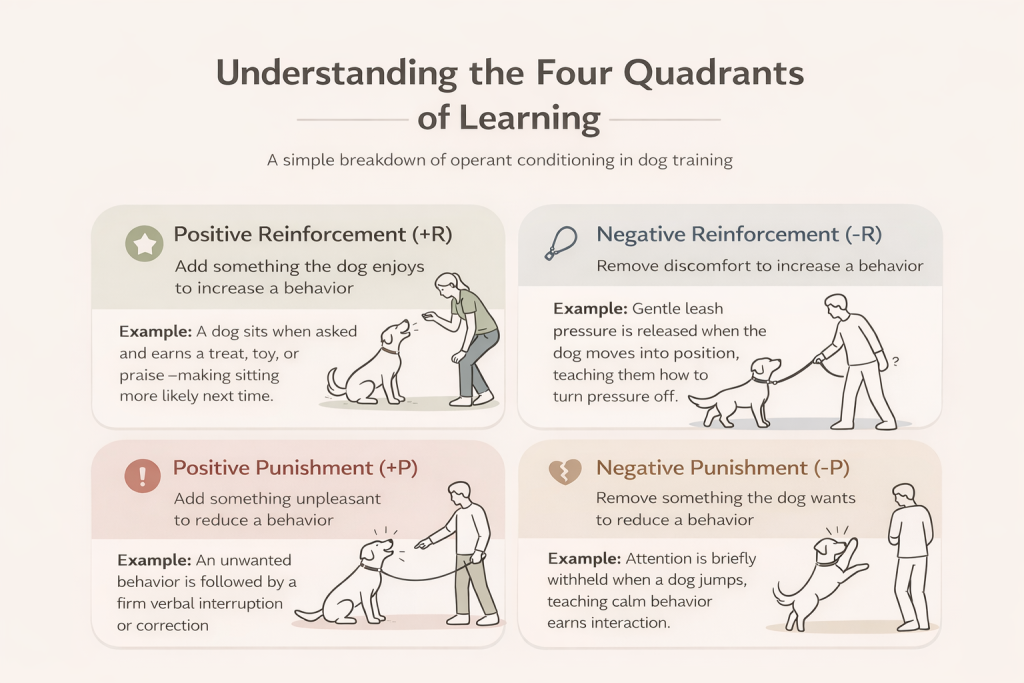
The Four Quadrants of Operant Conditioning
Operant conditioning is often described using four “quadrants.” These terms sound intimidating, but they simply describe how consequences influence behavior.
- Positive = something is added
- Negative = something is removed
- Reinforcement = behavior increases
- Punishment = behavior decreases
These combine to form four outcomes:
- Positive Reinforcement – adding something the dog likes to increase a behavior
- Negative Punishment – removing something the dog likes to decrease a behavior
- Positive Punishment – adding something the dog dislikes to decrease a behavior
- Negative Reinforcement – removing something unpleasant to increase a behavior
All dogs learn through all four quadrants naturally. Training philosophies differ in which quadrants they choose to emphasize—or avoid.
What Is Positive Reinforcement Dog Training?
Positive reinforcement training focuses primarily on rewarding desired behaviors so they occur more frequently. When a dog sits and receives a treat, praise, or toy, the dog learns that sitting leads to good things.
Contrary to a common misconception, positive reinforcement is not bribery. A bribe is shown before a behavior to coax compliance. Reinforcement happens after a behavior to strengthen it.
Core Principles of Positive Reinforcement Training
- Teach behaviors by rewarding success
- Manage the environment to prevent unwanted behavior
- Use timing and consistency to create clarity
- Minimize or avoid aversive consequences
Positive reinforcement trainers primarily rely on:
- Positive reinforcement (adding rewards)
- Negative punishment (removing access to attention, toys, or rewards)
Benefits of Positive Reinforcement
- Builds trust and enthusiasm for learning
- Encourages dogs to think, experiment, and offer behaviors
- Strengthens the human-dog bond
- Reduces fear and anxiety when applied correctly
Dogs trained this way often view training as a game and actively seek ways to earn rewards.
Limitations and Challenges
While powerful, positive reinforcement has limitations—especially outside controlled environments.
Common challenges include:
- Difficulty addressing dangerous behaviors quickly
- Reliance on rewards for compliance
- Reduced reliability in high-distraction, real-world situations
- Heavy dependence on management to prevent mistakes
Positive reinforcement works best when owners are consistent, proactive, and committed to ongoing training progression—not just reward delivery.
What Is Balanced Dog Training?
Balanced dog training combines reward-based learning with carefully applied consequences. The goal is to teach dogs what behaviors work and which behaviors don’t, using a full range of learning tools—thoughtfully and ethically.
Importantly, modern balanced training looks nothing like the force-heavy methods of the past.
A Brief Look at Training History
Historically, dog training relied heavily on force and avoidance. Dogs were corrected before they understood what was expected, creating confusion, fear, and fallout behaviors.
In the late 20th century, trainers began adopting reward-based methods inspired by marine mammal and exotic animal training—where force is impossible. This marked a massive improvement in canine welfare and training effectiveness.
However, over time, trainers and owners discovered limitations to reward-only systems—particularly when dealing with:
- Severe behavior issues
- Impulse control problems
- Off-leash reliability
- Real-world distractions
This led to the evolution of modern balanced training, which aims to blend motivation with accountability.

How Modern Balanced Training Works
Balanced training starts the same way positive reinforcement does: by teaching behaviors using rewards. Dogs are allowed to learn without fear of making mistakes.
Once a dog understands a behavior, consequences may be introduced to improve reliability and clarity.
A critical distinction in modern balanced training is that pressure is introduced as information, not punishment.
Dogs are first taught:
- What the behavior is
- What pressure feels like
- How their actions control that pressure
For example, leash pressure is introduced gently so the dog learns that complying removes the pressure. Over time, pressure becomes a cue—not a threat.
Only after this understanding is established are corrections used, and only when:
- The dog clearly knows the behavior
- The disobedience is willful, not confused
- The correction is proportionate and fair
Strengths of Balanced Training
- Can address serious or unsafe behaviors effectively
- Builds clarity and structure
- Often produces strong real-world reliability
- Helpful for high-drive or working breeds
Risks When Done Incorrectly
- Poor timing or excessive pressure can create fear
- Inexperienced handlers may misuse tools
- Requires professional guidance for best results
Balanced training is not punishment-based—it’s communication-based.

The Real Difference Between Positive and Balanced Training
The biggest difference lies in how mistakes are handled.
- Positive reinforcement focuses on rewarding success and managing failure.
- Balanced training rewards success and provides clear consequences once understanding exists.
Both methods can:
- Be humane or harmful depending on execution
- Succeed or fail depending on consistency
- Build confident dogs when applied thoughtfully
Labels matter far less than skill, timing, and ethics.
Choosing the Right Approach for Your Dog
There is no universal best method. What matters is:
- Your dog’s temperament and sensitivity
- The behaviors being addressed
- Your lifestyle and consistency
- Your willingness to seek professional guidance
Many dogs begin with heavy positive reinforcement and later benefit from added structure as they mature.
Final Thoughts
Dog training is not about control—it’s about communication. Positive reinforcement and balanced training are tools, not ideologies. When applied responsibly, both can produce confident, well-adjusted dogs.
The most important factor isn’t the method—it’s the human using it and HOW they use it.
Educated owners who remain fair, consistent, and emotionally stable will always outperform rigid adherence to any single philosophy.
If you’re unsure which path is right, working with a qualified professional who evaluates your dog as an individual is the best investment you can make.
Disclaimer
The information provided in this article is intended for general educational purposes only and should not replace guidance from a veterinarian, certified dog trainer, behavior consultant, or other qualified dog professional. Every dog and situation is unique—professional support is always recommended when addressing health, behavior, or training concerns.
Continue Learning with Us
Want to go deeper? Uncensored Dog members get access to premium articles, training plans, videos, and tools designed for real-life dog training and everyday challenges.